Tuesday, 21 February 2012

Some UKBC Photos (Newcastle)

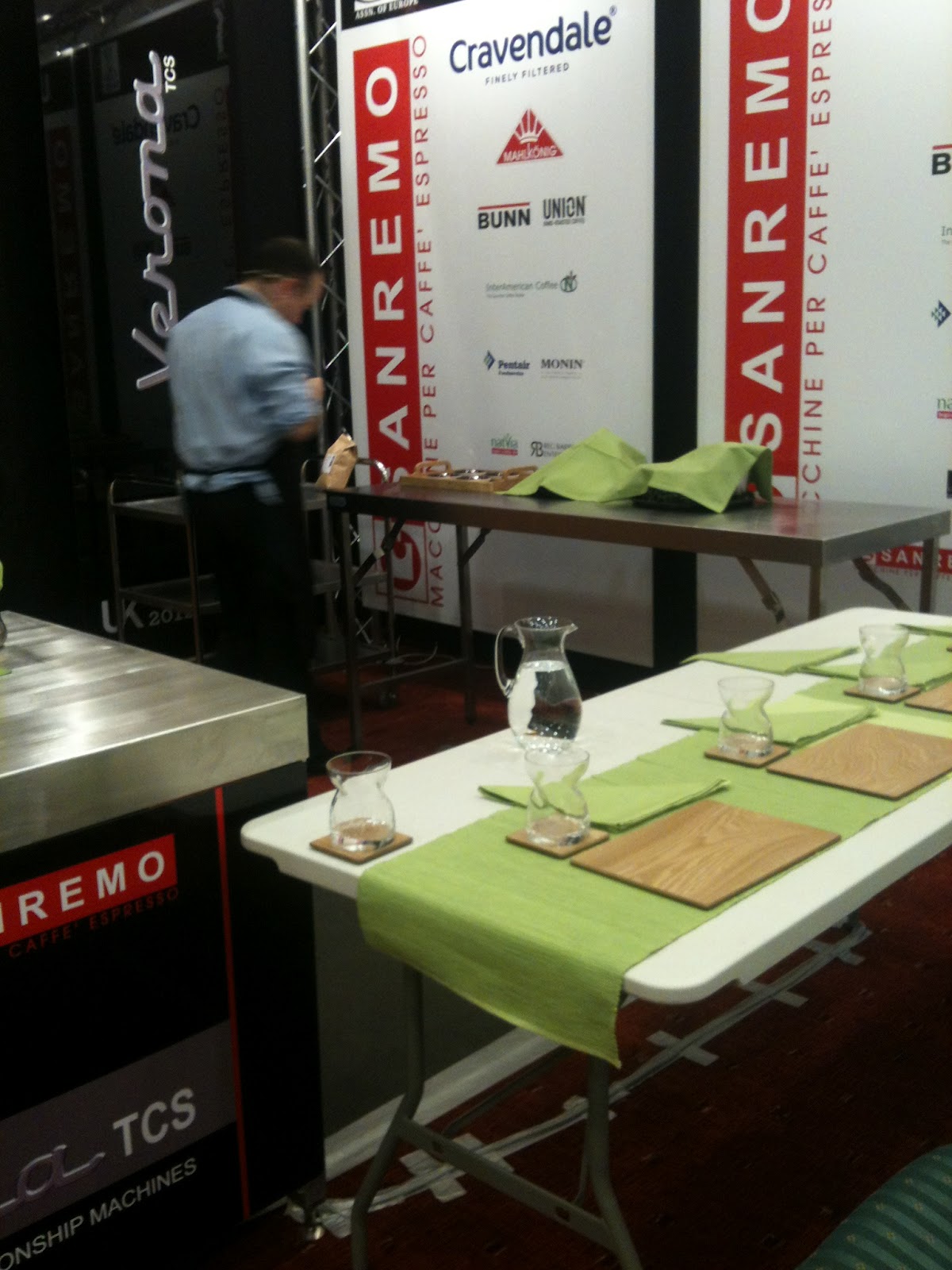
I had hoped to take more photos of the competitors and perhaps stream some live video, but ended up holding the video camera owned by San Remo, up at the front, so these pics are all I got.


Monday, 30 January 2012

Coffee Water Quality


This is something that has been weighing on my mind lately. It just feels like such a massively under-considered area. So much time and effort go into other coffee parameters, but when it comes to water I've found it really difficult to get much traction in conversations with others (apart from John Gordon, who seems to have dedicated a good portion of time to understanding the issues and also some options for addressing the problems he experiences). I am frequently advised to dismiss my water concerns, for one reason or another. It's not something I need to think too much about, apparently. Whatever the issues I have, I should address them through one or all of the following:
  • Adjusting my extraction technique to compensate
  • Installing the same filtration and softening systems as everyone else
  • Using bottled water (not very practical in a commercial setting, huh?)
  • Ignoring it. The SCAA water quality guidelines are outdated, they say,

I can't accept this, I'm afraid. That's not to say that the above are incorrect. Nor that they are correct. My point is, the whole issue is spoken about in such a blasé manner. Opinions are thrown around without a care in the world for whether they are based on any scientific evidence. It is just incredibly incongruous to be so laid back about this brewing parameter, in an industry where people are obsessive about things such as the normal distribution of hole-size in a portafilter basket!


Why the pushback?
But I think I know why people sweep it under the rug. I've attempted a few times in the past to get my head around water quality, and given up. Here's an extract from the first section of Jim Schulman's fantastic article on the subject:

Hardness is the term for the calcium or magnesium carbonate dissolved in water as Ca++, Mg++, and HCO3- (bicarbonate) ions. There are two measures of water hardness, hardness and alkalinity. Hardness measures the amount of positive calcium and magnesium ions; alkalinity the negative bicarbonate ions. Both measures are usually given in calcium carbonate, i.e. scale, equivalent units (abbreviated as CaCO3). This means when one unit of scale precipitates out of the water, hardness and alkalinity measured in CaCO3 units go down by one unit each.

I believe this illustrated that water chemistry is a very dry topic to a non-chemist. Most people in the coffee industry (certainly in the barista arena) are not accustomed to this level of science. Sure, we can proudly consider ourselves geeky and be proponents of coffee brewing as a science, not just an art. But it is rare to find someone who is happy to work as a barista for £8 per hour, and yet is also willing (or even able) to muster the concentration and willpower it takes to get a mental foothold on this topic.

The issues
So backing up a bit, just what are my concerns about water? Well at this stage I don't know what I don't know. I have suspicions, based upon some things I have read on the topic of coffee water quality. I'll continue...

Quality. Purity. What do they mean? In simple terms it seems to mean that there are very few particles (solids) within it other than the H2O itself. Particles might be minerals/metals, such as calcium, iron, potassium, and also things like faecal bacteria (yes... poo!) and substances that affect colour. (Click here for an explanation of ten key parameters in water quality, according to the Drinking Water Quality Regulator) We often hear talk in our industry of ideal water quality measured in parts per million (also known as micrograms per Litre mg/L) ... somewhere around the 150ppm mark is usually touted as good for coffee (although opinions differ). In many parts of the UK, and certainly in the UK's coffee capital of London, water is NOT pure. It is nasty, horrible, recycled piss and the taste of it confirms this. It has a high ppm (something like 300ppm in London). It is also very 'hard' (see below). This has an adverse effect upon coffee taste, as well as damaging coffee brewing equipment such as espresso machine boilers, which quickly develop scale. So to be fair, a good deal of work has gone into providing commercial equipment that can filter out some of this crap and also soften the water, so that problems like scale are reduced.

But where I live, the water is generally very pure, and very soft. Too pure and too soft... maybe. Very soft water has a high pH level – which is a measure of the water's acidity. Soft water does not cause as much scale in coffee equipment, so that's a good thing. But the acidity can apparently cause corrosion of parts, which is just as bad... perhaps worse if it means that corroded metal ends up in your cup of coffee! So does this mean we should increase the mineral content of pure, soft water that we want to make coffee with? I believe the answer is yes, but so far haven't had a great deal of support for this... either from baristas, coffee suppliers, or indeed water treatment specialists... which I suspect is for the reasons already mentioned.

And then there's the impact of that pH level upon the physical extraction of the coffee. Some say that soft water enables more effective diffusion of coffee particles from the grinds, so can result in overextraction if not carefully managed. Some say the opposite(!) - that soft water makes extraction LESS effective.

And even if you get the extraction right, what is the effect of this very pure water upon taste... will the coffee be overly bright and acidic? And therefore will the coffee flavour not match the experience of the roaster when he/she sampled and selected the beans, or when they were profiled and roasted? I don't want to pay good money for beans that could taste of peaches and cream, only to find that the water I'm using makes them taste of lemons and limes. Is this likely? I don't know, and despite some fantastic articles out there, I haven't yet found anyone who can give me an answer that I trust is relevent to my own local water issues, based upon science rather than supposition.

And even once I eventually understand and arrive at my own conclusions, there's the problem of finding appropriate treatment systems at an affordable price. Treatment systems seem to want to 'filter out', rather than 'add back'. For example, this presentation by boiler manufacturer Marco has some excellent points on the subject of water quality, but at the end refers only to filtration.
I know there are water additive solutions out there, but since I haven't found anyone who uses them, this raises all kinds of doubts as to whether they are really needed, whether they are any good, or whether they are readily available.

And this is, I'm sure, only part of the equation.

I've a long way to go on this subject, it seems.
___________________________________________________________
Read the follow-up post on Coffee Water Chemistry written 9 months later.

Wednesday, 25 January 2012

UK Barista Championships

I'd mentioned to some of the guys on www.coffeeforums.co.uk that I was heading to London for some events related to the UKBC, and was asked if I'd be doing my usual lengthy report afterwards. So I wrote the following piece and Glenn kindly put it up on the website as an article.

The main thrust I wanted to get across was that competitions are not purely for those good enough to win first prize.  Wimbledon wouldn't be much of a competition if the only people taking part were Rafael  Nadal and Roger Federer. It would be a match, not a competition.  All competitions need competitors, of all levels, rising through the rankings as they get better and better.  And entering the competition is in  itself a catalyst for getting better.
Read the article here
(Please forgive the typos!)

Wednesday, 11 January 2012

Pourover with V60-01

I love the exact moment when I realise I'm wrong. Why? Because it's a snapshot in time ... the precise second when learning has occurred.  I hope I never stop wanting to learn.

I'm an advocate of Scott Rao's books and work. In particular I have previously conducted some experiments in relation to his views on the 'high and dry' phenomenon that seems to be common in baristas' pourover technique.  As a result I've universally avoided ending up with any form of V-shaped cone at the end of my pourovers, aiming instead for the convex dome shape of grinds in the filter cone, that results from spinning the slurry during extraction and drawdown.

I was wrong.

But that isn't to say I don't still firmly support Scott Rao's assertions. I believe I just misinterpreted them.

Ongoing experiments have shown how vastly different the extraction of two different coffees can be, despite using exactly the same parameters and technique.  Obviously grind always needs to be adjusted to the current state of the bean, but grind alone is not the best way to achieve your target pourover results. Pouring technique must also be adjusted.

Sometimes there is no way to achieve a dome of grinds at the end of a pourover without resulting in over-extraction.  The stirring required to ensure that grinds are not left under-extracted at the rim of the V60 can cause too many solids to diffuse from the grinds, overshooting the target TDS.

For a week or so I've been trying to achieve a TDS of around 1.35% for a Tanzanian Kilimanjaro, but every time the reading came in at around 1.6% and the taste was too strong.  In the end I have managed to find a way to hit my target within an acceptably long dwell-time, but it has meant grinding a fair bit coarser and also changing my pour when brewing these beans.  The 'new and improved' pour is probably also better in terms of maintaining brew temperature. It involves a constant slow pour all throughout the brew, rather than many small pours. Infact at times it encroaches on a drip rather than pour.


With such a slow pour the grinds never have a chance to rise up the side of the V60. This means that at any point in time all of the grinds are being extracted evenly, and the 'high and dry' thing never happens. It also therefore means that there is no need to stir. The last 20g of water is just poured slightly quicker to ensure everything is covered, and then the drawdown is allowed to complete... the majority of which takes only perhaps 10 seconds, with residual dripping for a further 10 seconds.

The result is infact a small amount of concave coning of the grinds, but the majority of the slurry remains flat. I deem this acceptable since it has taken place over only the final 10 seconds of the brew, and also the slurry rim (the 'high' grounds) is just 1cm above the flat of the central slurry.

In the cup this works a treat. The TDS and Ext % are right, and also the taste is wonderfully balanced due to the grinds being evenly extracted throughout the filter.

Now I'm not saying this is how I'll be doing it every time. With a Mandheling I have at the moment a good stir with a chopstick at the appropriate time during the brewing process is absolutely the right thing to do, and helps me hit my target extraction.  The point is, there is no single correct technique. It seem that the skill lies in having a repertoire of techniques to enable an appropriate response to the how the beans are extracting.

My learning continues.  I reserve the right to compose another post in a few months, denouncing THIS post as complete bollocks!

Friday, 6 January 2012

Unclean Green Beans

On my trip to Bali coffee plantations last year I bought two small bags of green beans from the producers. I thought they might come in useful for practise roasts, since I'm planning to start home roasting soon.  The beans have been stored in a sealed bag until the other day, when I decided to transfer them to a plastic storage container.

I thought it might be interesting to compare their appearance with some greens that I bought recently from Hands On Coffee, a micro-roaster from Cornwall.  I got a bit of a shock!  I'm so glad I wasn't searched by HM Customs & Excise on my way back into the UK!! This video just goes to show the importance of sourcing your green beans well.

Does anyone know what these little buggers are? Coffee berry borer?


Saturday, 10 December 2011

Keeping a manual brewing log

A few days ago Cyclone Friedhelm (or Hurricane Bawbag as the Scots have named it) left around 2000 folks in our area with no electricity, floods, ice, snow, and in one case a burnt down house!  So in true Scottish fashion we headed over to the home of some friends, got drunk and stayed up late talking bollocks.  The electricity came back on at our place today so I'm lying on the sofa with a hangover and just thought I'd write a nice easy post that doesn't require brainwork or standing up.

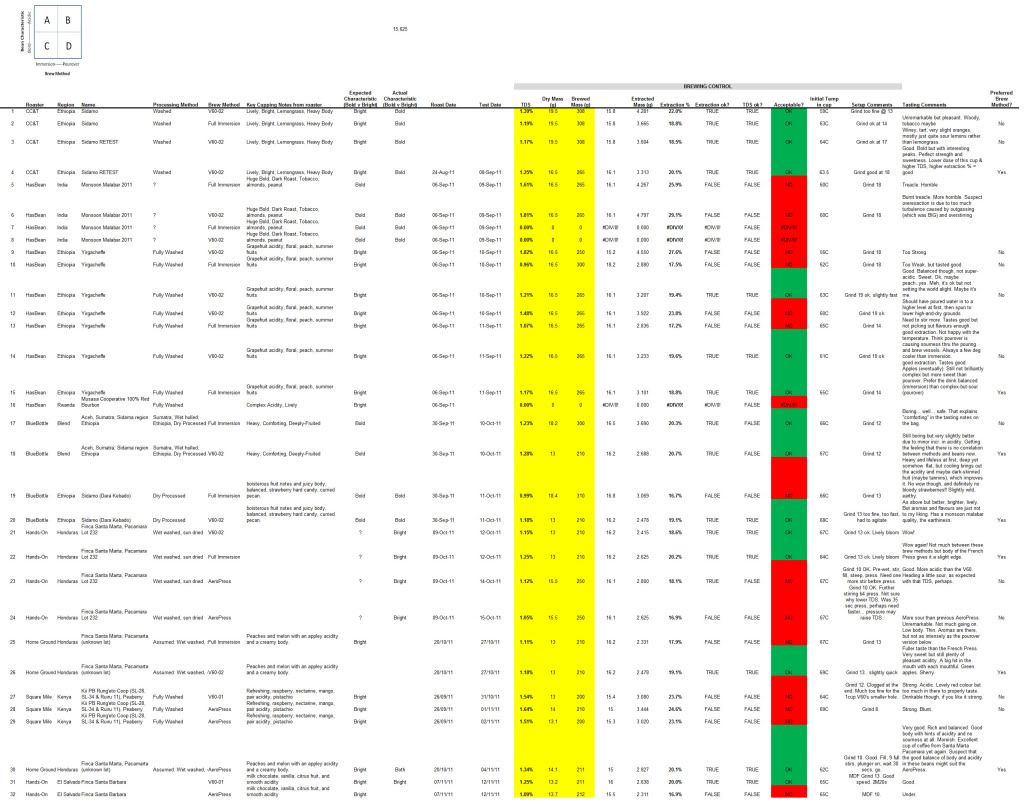
I've been meaning to write this post for ages.  For a few months now I've been logging some of my manual brews. The purpose was originally to provide data to answer a question that came to me a few months back... whether it is possible to match the predicted characteristics of beans to particular brew methods. Beans have many characteristics but I chose to focus on boldness and acidity on the assumption that coffees are either bold or acidic but rarely both. (Actually the experiment soon proved to me that this was a flawed assumption.)

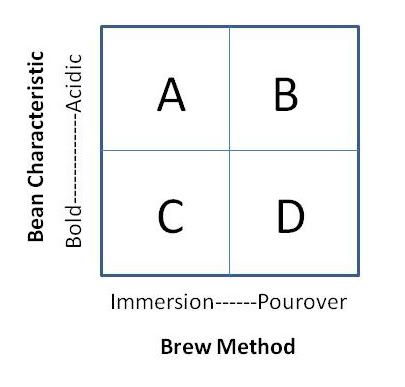
So for example, is a bold, earthy sumatran best suited to a French Press to retain as much of the body as possible? Or conversely, would it be best suited to a pourover, to bring out some of the beans' intrinsic acidity and therefore use the brew method to counterbalance the bold, earthy qualities.  Each brew would theoretically fall into one of the following four boxes, and if a particular box gets more 'hits' then that would indicate a brew method fitting well a bean's characterstics.

Once I thought about it, I realised that it was pointless to use coffees that were not brewed correctly as that would skew the results. I needed as way to control the brew, so I could accept or reject each brew.  Fortunately the Brewing Control Chart created by Ted Lingle of the SCAA exists precisely for that purpose. I bought a TDS meter to allow me to establish TDS and Extraction Yield (although I've already blogged about the device having limitations).

So, a few months ago I began logging the details of each brew ... the beans, the brew method, the temperature, TDS, Extraction Yield, my tasting notes etc. It didn't take long for me to start learning many things, including:

1. It is not as easy as I had previously thought to brew a coffee that falls into the 'Ideal' range on the brewing control chart. What I had thought was correct was wrong.  This is one of the pitfalls of over-reliance on websites like www.brewmethods.com to learn correct manual brewing. Those videos don't help you learn to adjust your technique to the current condition of the beans.

2. The current condition of the beans is constantly changing. I knew that, but I didn't fully appreciate just how much it can affect extraction during manual brewing.  For example, the bloom of very fresh coffee would increase extraction, so I would need to agitate the brew slurry less or more depending on freshness and bean gas.

3. Matching brew method to beans based upon boldness/acidity doesn't work. Every day the beans work best in a different brew method, because they are constantly changing.  You simply can't say "this bean should always be brewed in a French Press".  I had been told that it would probably be the case... but as always I prefer to learn through my own experiments rather than simply being told. There is a lot of opinion (rather than fact) out there and who are we to believe?


Anyway, this post is getting long and I'm getting more hungover so I'll bring it to a close.  The main point I want to make is how valuable my brewing log has been in learning how to perform manual brewing. I soon ditched the original purpose of the log, and just used it to record the details of each brew to help me move forward. I added new brew methods.  I inserted new columns, deleted others, tweaked the format of my comments so I could refer back to them in future brews, etc etc. It takes moments to fill in, which I do whilst waiting for the TDS meter to take the reading and drinking the coffee.

Here's a jpeg of part of my log.

Thursday, 8 December 2011

Coffee Cupping and Wine Tasting

I was directed (through twitter) to an interesting blog post today.
Click here to read it.

The wine connection is something I have spoken about in the past, so I started writing a reply in the comments. I got a bit carried away though, so decided to post it here and link to it instead. Here it is!


I do think coffee is following in the footsteps of wine, for sure. Twenty years ago the average wine consumer might have known little more about their preference than "Red or White", but now they are able to not only express a preference for, say, Sauvignon Blanc, and not also a particular region such as Marlborough, but even identify specific Marlborough estates such as Stoneleigh or Brancott... even across the other side of the world in the UK.

Coffee-wise, we're moving to the average punter (rather than coffeegeeks) being able to go beyond saying they like either black or milky, Americano or Latte, and now saying they like Rwandan or El Salvador. In time a larger part of the population will extend that to saying things like "Musasa Cooperative is my favourite", or "Do you have Finca la Fany?"

But I think there's a big challenge with going a step further and getting the general public to try and pick out aromas, to make a mental connection between their mouth and mind and be able to express what they are tasting. It hasn't happened with wine. Wine tasting events remains the domain of the 'buff'. Why? I think maybe because 'nornal' people just want to drink it.  It's 'just wine'. Analysing it can seem like spoiling the fun, and also has negative connotations such as Jilly Goolden's flamboyant, wildly descriptive and very posh assessments of various wines, which joe public can't associate with.

So how can we avoid a similar fate for coffee... avoid cupping becoming something to be derided by the very people we want to attract? This is a critical time in coffee's evolution, certainly here in the UK anyway, and if we get this bit wrong then coffee will remain 'just coffee' for most people. The simple answer, in my view, is to ditch the words snob, geek, connoiseur, and anything that suggests that you need to be elite to take part. One of the most common responses I've had from the public is "oh, I don't think my taste buds would be able to appreciate it". What a huge shame that we have conditioned them to think they aren't good enough. It's a lose-lose situation.

Let's turn it on its head. Let's make it accessible and fun. Make it a win-win. Hell, let's dumb it down if that's what it takes... give it the X Factor treatment. Coffee and cupping need to be fun. If they are fun then there's a greater chance that some of those taking part will see beyond the cupping 'party' and take a real interest in speciality coffee.  The challenge is to find creative ways to make it fun.

So is coffee cupping currently more fun than wine tasting? For coffee snobs, geeks and connoiseurs such as ourselves I'd say yes... but let's not forget who pays our bills. It would be good to take the focus off ourselves, stop showing off our own skills, and instead shine a light on the public and what they want, because at the moment I think most of them would say No, coffee cupping is not more fun. It's just coffee.