Wednesday, 23 November 2011

Romanes eunt domus?

"People called Romanes they go the house??"  - Life of Brian

I've been to Italy about ten times. My first ever foreign holiday back in my late teens was near Venice. I've been to Verona and Lake Garda on weekend jaunts when I lived in Germany.  Been skiing at Cervinia. My wife and I passed through Lake Maggiore on our honeymoon. Etc etc.

I've always hated it. It has always been, to me, a caricature of itself.  This picture pretty much sums up the people I've encountered.


I have kept going back though, partly because I wanted to find whatever it is that other people seem to love about the country, and partly because I was disapppointed with myself that I had failed on multiple occasions. Failed to make the most of my surroundings. Failed to adhere to my own belief that you cannot generalise about an entire country and its inhabitants.  I desperately wanted to like Italy.

Now I do!

Last weekend Jan and I went to visit some friends who have an apartment in the centre of Rome, near the Circus Maximus. I had mixed feelings about the trip, what with it being to Italy, but was keen to see our friends and also to give the place another pop.  All the areas I have visited previously are in the North of the country, whereas Rome is more central. I wondered if there would be differences that might make me like it.  After all, back home there's a big difference between, say, Manchester and Norwich.


There were indeed differences. Massively so.  I expected a big, dirty city with too many cars, rude waiters, gaggles of fashionistas blocking the pavements, corporate tower blocks all over the place, and all food & drinks costing a small fortune.  Nothing could have been further from the truth.


Rome is a wonderful city, at least in the tourity central parts I visited. In a way, it didn't really feel like a city to me. Walking around the place was more like ambling through the streets of Bruges (Belgium), or the shambles in York (UK).  Cobbled streets, horse-drawn carriages, beautiful old buildings, and a genuinely friendly vibe from everyone in the shops and streets.  We were there three days and I'd go back tomorrow if I could.


We weren't there specifically for the coffee, but I was keen to try several espresso bars since I understood there to be some difference between Italian espresso and the 'third wave' style of espresso we might find in a good coffee shop elsewhere. 


Just around the corner from the apartment was our first bar.  Lesson #1... there is no such thing as a coffee shop. Look for the word 'bar'.  Our friends had recommended it, not so much because of the coffee but more for the environment.  It was beautifully adorned in smooth wood all over the place... walnut I think.  I asked for an espresso macchiato. Actually I'm not quite sure what I got! It may have just been an espresso, or the 'mark' of foam may have been so small it got lost in the crema.  Crema! There was actually some sort of crema. That surprised me a little, as I had expected Italian espresso to be a little flat. My understanding was that they don't put so much emphasis on bean freshness over there. As with all the espresso I was to receive over the weekend, it was a single and was pretty much knocked back whilst standing at the bar.  Result? Quite good. Nothing to write home about, but better than I had anticipated.  Not bitter. It seemed high in Brazilian flavours and little else, if my palate is anything to go by.  I looked towards the grinder to see an opened bag of Segafredo. Interesting. All the Segafredo I've tasted in the UK were nasty, and this espresso certainly wasn't.  The cost... about 1 Euro... 86 pence in Stirling. Cheap!


It was a fleeting visit, and we set off walking the streets of Rome fairly aimlessly.  We were right next to the Palatine Hill, and decided to skirt up the West of it, following the main road past the sites of various archaeological digs. These sites abound in Rome. Tony Robinson would be wetting himself with glee!


Soon we came to a big, old, round building, conveniently next to a bar/caffè called Antico Caffè del Teatro di Marcello, revealing that the circular building is an ancient theatre (and not in any way, shape or form The Colosseum, although as a Rome newby it did briefly cross my mind!).  The espresso here had less crema, was black and bitter... exactly like I've had from many cafes back in the UK except shorter (thankfully). Brazil came through strongly once again - or at least a very monotone flavour that I have previously found in 100% Brazilian espresso.  It was mid-late November yet it was lovely to sit outside in the 18C sun.


Heading off the main road and into the cobbled lanes towards The Pantheon.  I'm not massively into architecture but this place is fairly spectacular inside.  Anyway, just off from here is a little old bar that was recommended to us, called Antico Caffe della Pace.  Seriously impressive decor and atmosphere here, and equally beautiful espresso equipment, including a 3 group Faema E61 and a lovely looking rippled grinder (I couldn't quite make out the brand but think it was 'Mador').  Despite having lived in Italy previously, Jan had a lapse in concentration and ordered a latte... promptly receiving a glass of warm milk.  I ordered a caffe corretto... an espresso with a shot of grappa, although I was surprised when the barista's first suggestion was Sambuca.  Needless to say, with a shot of grappa in it the espresso wasn't something I could comment on! But the place was amazing and I'd love to go back.

 Over the next two days we hit a bunch of touristy things... Colosseum, Trevi Fountain, Spanish Steps... all of which were actually really lovely and not noticably spoiled by their status as tourist hotspots.  The Colosseum in particular is quite awe-inspiring for many reasons, not least being the sheer scale of the place.  After spending some time walking around it and hovering on the edge of guided tours getting a free insight into what really happened in the time of The Gladiators, we hopped in a taxi up to Tazza d'Oro, a coffee bar that is reputed to be one of the best in Rome.  Again, it is right next to The Pantheon, and from the outside it doesn't look much. Inside, however, it is a bit of a baristas dream.  There's an old-looking roaster on site, which I'd estimate to be perhaps 15kg although I could be wrong.  Two Wega espresso machines, both four group, sat on the bar... one at either end.  Several grinders were filled with many different types of beans/blends.  Those beans also filled large glass cabinets under the service area, and also in the back room where an elderly gentleman filled up 250g bags on demand, and a long queue of customers lined up awaiting their fix of whole beans (yes, I bought some!).  It was unlike any of the other bars.  In some ways it felt more modern than the other espresso bars, more 'third wave', in the way it seemed to be promoting freshly roasted speciality coffee. But on the other hand it actually felt older, more traditional, than any of the other places, in the sense that this is perhaps how things used to be in Italy before the advent of mass commercial roasting.  It was spectacular, in my humble opinion.  


Jan's cappuccino had a heart on the top, which was once again different from the other bars. What wasn't different however was my espresso, which was once again a very drinkable but fairly bland affair. No bitterness thankfully, despite the beans in the hopper being quite a dark roast, and despite the grinder's dosing chamber being full, but not much complexity or acidity in the cup.  I thought I wasn't a big fan of acidity in espresso, but you don't know what you're missing until it's gone! Still, I enjoyed it anyway, and was also enjoying single espressos because it meant I could have another!! One thing I noticed here and in every other bar was that they don't use a tamper, preferring instead to apply a light press of the portafilter against the tamping attachment on the grinder.  It makes me wonder if they grind finer to make up for the softer tamp, because the extractions were invariably good visually.  They also don't seem to be too bothered by mess and old grinds, either on the portafilter basket or on the grouphead... or about wiping down the steam wand after steaming milk.  I couldn't help feeling a little disappointed at that.   
Cost: Espresso = 0.90 Euros.  Cappuccino = 1.10 Euros. What a bargain.


Next morning we went to a small farmers market near Circus Maximus, where there was a small shop selling coffee and cakes called Cristalli di Zucherro. It was a lovely modern little place, kind of like a French pattisserie.  Standing room only, which was fine as many customers were happy to stand outside in the sun. I liked the place.  They had a La Marzocco espresso machine, so I got my hopes up. The espresso, however, was fairly grim unfortunately.  I looked up and saw a shelf containing 19 one kilogram bags of beans - quite a lot for this small place, unlikely to be used up in a hurry, and probably part of the reason for the less-than-average espresso.


Whilst Jan and our friends got stuck back into the farmers market I did a quick runner around the corner and lo-and-behold there was another bar, just as I'd hoped! It was a nameless little place selling Lavazza through a nice looking 3 group Faema Emblema.  Tasted ok... a bit 'meh', as I'd come to expect by this point. What is great is that in Rome it seems you can find these places within 100 metres of wherever you are.


So in summary, I loved Rome, I enjoyed the espresso bars, and liked the actual espresso.  I wanted to find out whether it is somehow better than the espresso we love in the UK.  In my view it absolutely isn't better.  But that isn't to say Italian espresso is worse.  There are pros and cons in comparison with UK espresso.
I think the things we do better in the UK are:
- The freshness of the beans we use (in speciality coffeeshops at least... or indeed in our homes!)
- The frequent equipment cleaning that some of us here adopt
- The wider and more creative use of beans from around the world in our espresso compared with the predominent use of Brazilian beans in Italy (or at least in the places I visited)

However, there are some very clear things that they do better in Rome:
- I think the baristas over there are possibly more skilled than the average UK coffee-puller, since I did not experience a single bad extraction.  Despite an careless approach on the baristas' part, they consistently seemed to pull a good looking shot, of a lovely brown colour, in a good extraction time, of an appropriate volume.
- The Italian people actually drink espresso! It's great to see so many demitasse cups being wielded by customers.
- It is much cheaper.  I mean come on... a quid for a cappuccino. Granted it's only a 6 or 7oz cup, but the lower price makes it much easier to drink coffee more often. No wonder it's a big part of Italian culture.  (But I suppose part of the reason it is cheaper is that the beans used are not as good as the UK ones.)


If I had to choose between the two, I'd prefer a UK espresso... BUT only if it was prepared by a good barista in a good coffee shop using good beans, and there are simply not enough of those in the UK yet.  If it was a choice between an espresso from a random cafe in the UK, versus a random cafe in Rome, I'd choose Rome every time because I know it would at least be drinkable, unlike the horrible bitter crap that most UK cafes serve.

One question that I have not answered in my own mind is whether the darker roast adopted in Rome is better or worst than what we have in the UK.  My inclination is to think that it is worse, since the espresso is more bland due to the lack of varietal distinction and acidity, which is not replaced by anything as it becomes darker.  There was no increase in sweetness, for example, so I question the benefit of roasting darker. But as I say, I am happy to leave that door open. It gives me another reason to return to Italy. Perhaps I'll go further South next time!

Tuesday, 8 November 2011

COM-100 TDS Meter (2)

Response received from HM Digital.

The COM-100 does have automatic temperature compensation (ATC), but with very hot temperatures off the baseline of 25C, it will take some time for it to adjust.  You will either need to let the coffee cool, or allow the meter some time to stabilize.  There's no way around this.  The TDS level will be the same at any temperature - it's just a matter of giving the meter some time to adjust for temperature discrepancies...  It does not need to be 25 degrees, but the closer it is, the faster you can obtain the reading.
Good to get a response, but unfortunately it doesn't ease my mind about how useful the device is to me.  I've already unsuccessfully attempted leaving it for five minutes to reach a stable reading,  and if I need to let it cool to something like 50C (as a maximum) to get a credible reading then the coffee is no longer good for drinking.

The best I can envisage is that I adopt the following method:
1. Brew
2. Taste and assess
3. Leave to cool and take a reading at 25C
4. Discard the coffee
5. Try to replicate the parameters on future brews.

In theory that should be fine, since of course I don't want to measure every brew, but it also means that there's a slight disconnect between assessing the coffee's taste characteristics and obtaining a meter reading.  I wonder if this limitation is typical of all TDS meters, including refractometers.

Tuesday, 1 November 2011

A Brief Interlude: The COM-100 TDS Meter

I've suspended my AeroPress testing for a short while because I've hit a snag in my brewing tests.  I use the COM-100 TDS meter, since it is a relatively inexpensive way to obtain figures for TDS and Extraction Yield in manually brewed coffee. I use it in addition to tasting, to establish whether I have found the correct brew parameters to create a great tasting coffee.

I already know from reading other blogs etc that there are accuracy issues with TDS meters. For example, the aren't actually measuring TDS. They are measuring Electrical Conductivity, as a proxy for TDS, and then using conversion factors to derive a PPM (parts per million) reading.  But anything is better than nothing... perhaps!

The problem I'm having is that Electrical Conductivity changes depending upon temperature. The COM-100 is supposed to be set to compensate for that, but I'm finding that I get completely different TDS/EC readings depending upon the coffee's temperature.  For example, at 68C the TDS might be 0.90%, whereas at 45C it might be 1.65%.  In coffee terms, that is a vast difference and renders the reading unusable.

I've emailed the manufacturer, HM Digital, to see if they have any suggestions.  In the meantime, I immediately feel like someone has stolen my security blanket! I haven't been using the TDS Meter very long, but it's amazing how quickly I seem to have become psychologically dependent upon it, not trusting my own palate.  Perhaps it's a good thing to have a break from the technology and rely purely on tasting for a while.

[See follow-on post here]

Sunday, 30 October 2011

Messing with the AeroPress (4)

Quick post... I tried Jeff Verellen's AeroPress technique, or at least as best as I could understand it from the description on the WAC website, and my significantly lower skillset than Jeff.
17g grounds
270g water
Threw away the last approx 50g of brew slurry rather than pressing it into the cup - and also lost some in absorbtion.
I suppose I didn't quite follow the recipe, as my brew water began at around 95C rather than 80C.

Result
TDS 1.24%
Extraction Yield: 15.0% (based upon ending up with 205g of coffee in the cup.  But I'm not exactly sure whether I should be using 205g or 270g in the formula, for reasons stated in my previous blog post.

I enjoyed it. It wasn't stunning, but I enjoyed tasting the higher TDS than I've been achieving over the past few days.  A while back there was a brief discussion regarding whether it is possible to taste the level of extraction. I think you can, because there was something lacking from this brew... despite the TDS being 'in the zone'.  It tasted of good coffee, wasn't bitter, had a decent body and mouthfeel, but was just... erm...  'simple'. Not complex. I couldn't pick out much. It didn't linger on the lips - vanishing quickly and leaving nothing to remember I had ever tasted it.

But this was just one attempt, and one attempt isn't enough to judge - it's only enough to record my findings so I have something to compare with upon the next attempt.

Friday, 28 October 2011

Messing with the AeroPress (3)

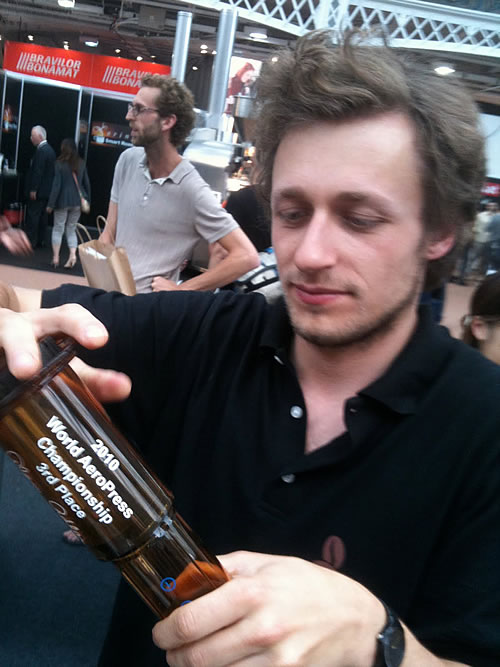
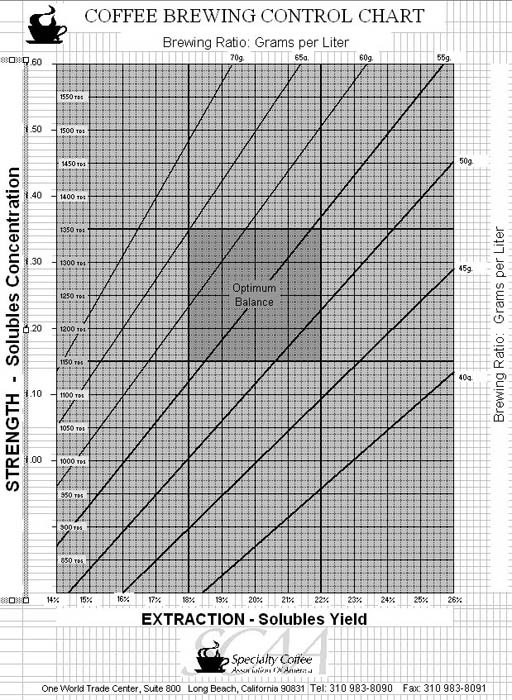
Before I continue with these AeroPress brews, just a quick comment on the World AeroPress Championships.  I just read the technique devised by this year's winner, Jeff Verellen, here. I love reading the details of how other people conduct manual brewing.  There's a lot of creativity involved in taking something as simple as the AeroPress, or the V60, or the French Press, and making coffee in a way that is somehow different from how others have done it in the past... whilst not tipping over into obviously using a technique for the sheer novelty value.  What I especially like is when the 'rules' are bent or even thrown out completely to produce something that tastes good without disrespecting the work that has gone into bringing the beans to the brewer's possession.  Don't get me wrong... the Brewing Control Chart has vastly improved my understanding of manual brewing and hopefully helped me make better coffee.  However, I've never liked the idea of rules that restrict innovation and experimentation... so I like to think of the charts and established brew targets as guidelines rather than rules.  (But perhaps I can only get away with saying this because I'm not experienced enough to know otherwise!)

So... as the above link shows, Jeff used 17g with 270g of water... a 1 to 15.8 ratio. However, he apparently ditched the last 50g during the downpress... the link refers to that 50g as water, but I presume it is actually the brew slurry.  So that would leave 220g of coffee... perhaps actually more like 205g when you take into account water that is absorbed by the grinds and therefore doesn't pass through to the cup.

I'm intrigued by this.  It reminds me of the way some people describe a ristretto as simply stopping the shot early (which I don't agree with). When you do that with espresso I believe you're going to get a rich shot with a high TDS, but a low extraction yield (I could be wrong... that's just my current understanding). Once again it's the "over-dosed and under-extracted" scenario that annoys Mr Hoffman so much. 

I wonder... does this apply this to Jeff's AeroPress technique?  There is a difference. In an espresso basket I'd imagine the pressure throughout the puck, and the extraction of the grounds, is relatively even (granted the pressure at the top will differ from the pressure at the bottom).  Whereas in the AeroPress the grounds are floating around in the slurry, and only the grounds that are hitting the filter paper are achieving full extraction. The rest of the grinds/solids are still floating around during the downpress.  So if you don't press all the way down, then actually not only are you using only some of the water, but you're also using only some of the grounds.  The brewing ratio isn't actually 1 to 15.8.  It is a completely variable brewing ratio depending how many grounds happened to be floating and how many happened to be up against the paper filter at any moment during the downpress.  OK, I realise there is also a 'full immersion' element of the brew, not just what is going on at the point of contact with the filter, but since 50g of the slurry is being discarded (along with the extracted solids sitting in that slurry) then the effect of full immesion is reduced, and the brewing ratio is still very difficult to quantify. It is also, arguably, impossible to repeat with any level of consistency.

I'm not being critical of this brewing technique at all, by the way.  I'm just trying to understand it more by putting my thoughts down on this blog.

So whilst writing this blog post I've been finding and reading a few forum and blog posts... notable the following:
1. A thread on coffeegeeks, with some useful links.
2. One of those links was to the ever-useful blog of Marco's David Walsh, and this post (good comments below it too).
From the above reading I found that it's quite common for AeroPress brews to be updosed and underextracted (rightly or wrongly).
"So does this suggest a kind of mass hysteria among speciality coffee folks, a laziness in technique due to increasing bean quality, or perhaps that the 50+ year old standards are inadequate?
The answer is probably not 100% any of the above"  - David Walsh
Anyway, I'll keep reading but I'm now at the point where I want to at least try, as I said in my last blog, updosing my AeroPress brews.  I'll start at 1:15 and get increasingly stronger.

After that I'm thinking of going back to 1:16 and varying other parameters... grind, maybe even the grinder itself, perhaps using two filter papers rather than one to increase TDS (as suggested by Roland Glew), etc etc.  

Must remind myself where I'm going with this!  I'm initially aiming to get inside the 'ideal' brewing zone. Using that as a foundation, I'll then adjust parameters until I find out what my palate likes in terms of TDS and Extraction %.

Now, since this post has ended up longer than I expected, I'll hang on until tomorrow to post actual brewing results! 

Monday, 24 October 2011

Dialing in the AeroPress (2)

Since my last AeroPress brews I've been having a think about how else I can tweak the brew parameters to reach my target extraction.  I've tightened the grind, I've tried different press speeds, I've allowed the steep time to encroach upon 1min 30 secs, which I think is more than reasonable for this brew method and I wouldn't want it to take any longer. So two questions remain:
  1. Why isn't the TDS higher?
  2. How else can I increase it? 

Why isn't the TDS higher
I need to continue thinking about this more, but I think I'm not getting a good enough diffusion process to pull out the solids from the grinds. Possible reasons (ignoring the parameters already mentioned) include:

  • Water temperature too low... I doubt it. I'm being very careful here (remember the übercosy?)  although there's a balance to be found between the longer steep time and temperature loss.
  • Dose too low.
  • Problems with the grind ... perhaps particle distribution rather than size setting. The Ggggia MDF isn't a bad domestic grinder at all... underrated in my opinion... but perhaps there are issues that I hadn't considered.
I shall continue to muse, but in the meantime I'm going to increase the dose as it is the easiest one to vary.  It may reduce some of the sourness I'm getting too... which I'm sure isn't coming from low brew temperature.

I typically work to a 1:16 ratio but I'm going to go richer, first trying 1:15 and seeing how it goes.

(As an aside, at this point in time I prefer working to brewing ratios in the format of 1:15 - i.e. weighing the grinds AND the water - rather than, say, 60g/litre. My preference stems from my espresso approach to brew methods... there is now (finally and thankfully) a trend towards using weight to measure and control espresso shots. For example, Square Mile have the following sugggested brew parameters for an espresso on their website:


18g in  ... 27-29g out.
Using a consistent unit of measure just seems more appropriate to achieving consistency.)

Brew (I've decided to stop numbering them!)

To be updated later today...
Nope... had to take Lulu the cat to the vets. Updated another day :)

Monday, 17 October 2011

Dialing in the AeroPress

French Press... tick
Hario V60... tick
Time to get a better grip on the AeroPress.

The first thing I wondered was 'should AeroPress coffee be brewed according to the Brewing Control Chart?'
It's arguably a different beast... not immersion, not pourover, and definitely not (as it claims to be) espresso . People tend to talk in terms water volumes with the A/P (e.g. "fill it up to the number 4 marker") rather than weight... and the variety of approaches to brewing with it don't all seem to follow the typical 1:15, 1:16, 1:17 type of ratio.

But ultimately, after running a few preliminary cups and reminding myself how it tastes, I've decided that it's still brewed coffee and simply a hybrid of French Press and Filter, despite the pressurised element. (I'm thinking that perhaps the main benefit of the pressure plunge is to increase agitation to provide a faster extraction of solids.)  I therefore do need to work by the charts.  I'm also, at least initially, using scales rather than markers - although I expect that will change once it becomes clear whether the marker can consistently represent a certain weight of water.

First Brew
I brewed directly into the cup, which holds about 250g of water, so that's the amount I used to brew with... and therefore using approximately a 1:16 ratio I measured just over 15.5g of bean, grinding and then ensuring that was the weight I ended up with in grinds.
Setting 10 on the Gaggia MDF grinder.
Honduras, Finca Santa Marta Lot 232, Pacamara, roasted by Paul Travis at Hands-On Coffee in Wadebridge, Cornwall.
- Approx 40-50g pre-wet, with a little bit of blooming then seven or eight stir... all in about 30 seconds.
- Fill to 250g, which is around the number 4 marker
- Place the plunger on to create a vacuum, preventing dripping into the cup (I'm not inverting the A/P).
- Leave for 30 seconds... hence an element of full immersion

- Plunge, taking 30 seconds to reach the bottom... stopping at the first sign of a hiss of air.

It tasted good.  More acidic than the V60.  It was heading a little into the sour range though.
Taking a reading helped explain why. Although the temperature in the cup was fine at 67C, the TDS was a little low at 1.12% (bearing in mind I tend to aim for between 1.15% and 1.45%, as a combination of SCAA, SCAE and Nordic controls). Extraction Yield was 18.1%, which is fine.

Second Brew
OK, so I thought maybe this time I needed to stir more just before plunging, which I did.
However, the TDS this time was only 1.05%, and Extraction Yield 16.9%... and it was more sour.  Why? Well I did plunge slower ... around 35 seconds. Maybe there was less agitation because of that, and I need to plunge quicker to get the TDS higher and extract more solids. Alternatively I know I could simply grind finer, but where's the fun in that? :)

Third Brew
I had a change of heart and tightened the grind from 10 to 9. I also plunged faster... around 22 seconds.
Result: TDS of 1.17%, Temperature 66C.
Tasted great and left a fantastic buzz on my lips and the roof of my mouth.
Although the TDS is within target, it's still at the low end of the range. Let's try again and aim for around 1.35%.  Perhaps this will need a grind setting of 7...

Fouth Brew
Grinder on 7, a 20 second plunge. Doh! I forgot to stir a second time just before the plunge. That stir is critical, since the TDS ended up being only 1.10%. Taste... sour.

Onwards and upwards/downwards...