Friday, 13 April 2012

Heat Exchanger Temperature Surfing Research

This is a follow up to my earlier post "My UKBC Prep And Practice Area" and the brief discussion in the comments area below it. It's about traditional barista skills rather than about the UKBC, and it's a little long and probably quite boring for many readers. You have been warned :)

Times have changed
Espresso technology has moved on. World Barista Championships machines (and individual national/regional events) are run on machines with very stable temperatures as a result of using multiple boilers combined with PID digital temperature control on each brew head. In this working environment baristas tend not to worry about achieving a particular temperature profile. (Perhaps this is why pressure profiling has become more of a consideration.)

But I own a Heat Exchanger machine (a commercial Faema Enova), which is now considered old school amongst many well established baristas. The upshot is that I DO need to worry about temperature profiles, and need to be able to control my brew temperature using manual techniques. I am the PID!

I could of course just sell my HX machine and upgrade to more modern technology, but a big part of me thinks it would be a cop out.  I see learning how to get the best out of a HX machine as part of my apprenticeship as a barista, so that I have a stronger foundation and understanding if/when I do eventually upgrade. Some would say I'm foolish for taking this approach... and I might even agree. Maybe it's a trait I've inherited from my father, but I've never been one to take the line of least resistance. Good things shouldn't come easily.  Also, I feel there's something in my approach that is respectful to those who have gone before me over the years, who came up with theories, developed ideas into practical processes and solutions, and ultimately paved the way for today's technology... for example:


and although his was a slightly different field, this gentleman, who sadly passed away recently at the grand age of 90 --->


Getting back to Temperature Surfing
Anyway, I've talked about temperature surfing for a long time on www.coffeeforums.co.uk, and performed it to an adequate degree on my single boiler (non-HX) Gaggia Classic, but as I researched more recently, and due to helpful pointers from the comments in the aforementioned blogpost, I came to realise that I didn't actually know very much about how HX machines work, how their design influences brew temperature, and how to control the temperature to produce, on demand, different temperature profiles throughout the shot.

I've now read more, and walked the google trail, which led to hacking my way with a machete through the forums jungle from thread to thread spanning several years of posts1 .  I now feel a little better equiped to use a HX machine in a controlled and accurate manner.  Here are some of my findings. As always there remains a lot more to learn, and once again I'm not saying anything new. I'm just documenting my learning path.

So... HX machines have a temperature hump. When not in use the water in the exchanger heats up and circulates around the brew head, resulting in brew water temperature becoming too high. This is visibly evidenced by steam and spitting when the brew button is pressed.

My machine is built to be powered by a three phase electricity supply (415V), but has been rewired to operate on a single phase supply (240V), which is the standard voltage in the UK. This began to worry me recently as I wondered whether it might affect temperature stability, and might make the hump more pronounced. By this I meant that at the start of the shot the brew water temperatre would be low, rising to a peak in the centre of the shot time, and tailing off to a low temperature at the end of the shot.  After exploring the design of the HX system and the E61 group head I'm now no longer worried. I'll explain why, but first let me show something that contributed to my concerns.

The "HX Love" article on Home Barista (see notes below) discusses the humped profile and profides the following diagram.
Figure 1. Temperature Profile of a commercial HX machine

The author, Dan Kehn, also posted the following video.


So I proceeded to track my own machine's hump. This is with an empty basket and a single spout. (My video is obviously in degrees C rather than F)


Here are the temperature profile results of several logged flushes.
Figure 2. Temperature Profile of my commercial HX machine.
First off, there are a few mitigating factors to consider here.
1. My temperature probe is inexpensive, and therefore not fast acting. I estimate a 2 second delay between probe reading and display.
2. There is also approx a 1 second delay between my pressing start on the timer and hitting the brew button.
3. Whilst the probe is rising in temperarure (playing catch up), the water temperature is actually coming down... even though the chart shows it rising.
(The important point is that the chart shows the point at which the water temperature peaks.)

The point however is that I could not understand why my temperature tailed off to around 75C in 30 seconds when Dan Kehn's seemed to stay fairly high. This baffled me. Actually I do still wonder about it, but not much because I now realise I was looking at this all wrong.

The profile shown in Figure 1 is not comparable/compatible with the two videos beneath it and with my own temperature profile chart. It must relate to the temperature DURING BREWING... i.e. with a full portafilter basket! No wonder I could not replicate it. (I feel stupid for my mistake, but can also see how easy it is for someone to make that mistake.) The throughput of water from an empty basket is perhaps six times greater/faster than when the basket is full. That is, a full basket may take 30 seconds to fill a 2oz glass, whereas an empty one will only take perhaps 5 seconds.

Not having taken the time to properly understand this scenario, I had thought my machine's temperature stability was extremely poor, and begun to wonder if the single phase conversion had caused this.

I have now learned more about the HX system. The brew water comes from the circulating HX system. Operating single phase will not affect temperature stability because the temperature is regulated by the temperature of the water in the boiler, which remains relatively constant as no water goes into or comes out of it when brewing espresso... only when running water through the hot water dispenser, or venting steam from the wand.  Inbound water directly enters the circulating HX system and mixes with the water already in there, replacing outbound brew water.

So what?
Well, first off I've used the chart in Figure 2 to provide an indication of how long my flush needs to be in order to achieve a fairly flat brew temperature profile.  At around 9 seconds the hump has reached its peak. The temperature has maxed out and the brew water is no longer steam, and is no longer spitting. Adjusting for the 2-3 second delay mentioned above, I now know that a 6 second flush will get my machine to 92C.

Secondly the brew temperature will stay at approx 92C for 7 seconds when flushing with an empty basket. The water throughput during this time is approximately 3 oz, which is of course sufficient to produce a double shot of espresso (taking into account water retained by the puck during expansion of the grinds).

Thirdly, after this point the brew water temperature would slowly tail off, but that is irrelevant as brewing would have ended by then and the HX system continued reheating the circulating water.

Fouthly, if I want a hotter or cooler brew temperature (within a degree or two) I have options. Reducing or increasing the flush time is one way to do it on the fly, and I can use Figure 2 to indicate how many seconds to reduce/add to the flush.
OR
If I want the machine to run at a higher or lower temperature more permanently (to suit a particular batch of beans, for example), I can adjust the pressurestat. This will increase/decrease the boiler water temperature, which will in turn increase the HX brew water temperature. (If I do this then I presume I will need to rechart the temperature profile of the flush.)

I am still unsure as to how long I should wait between the flush and inserting the portafilter/pressing the brew button (i.e. the rebound time), and plan to continue researching and experimenting with my machine to see what effect different rebound times have.

Some conclusions
Oh, I dunno! I learned some stuff. I have more to learn.
I guess one conclusion is that www.home-barista.com is not just for home baristas.  Most of the things I've learned in this session have come from that website/forum and are completely relevant to burgeoning profession baristas such as myself. The folks who posted such amazingly informative articles on there are certainly not amateurs. We find learning wherever we can get it, and hopefully in writing this blog I will help someone else to gain access to learning resources more easily. Also, if anyone reading this finds that I've misunderstood or missed something then please feel free to post a comment prodding me in the right direction. Self-education is prone to error!!

Notes
1. Here are some pieces of the trail:
http://www.home-barista.com/espresso-machines/espresso-machines-101-t368.html
http://www.home-barista.com/hx-love.html 
http://www.home-barista.com/espresso-machines/e61-group-espresso-machine-detailed-interior-schematics-t397.html
http://www.home-barista.com/espresso-machines/do-all-types-of-espresso-machines-have-to-be-flushed-t16037.html
http://www.home-barista.com/junior-buyers-guide.html#_groupTest
http://www.home-barista.com/naked-extraction.html 
http://www.youtube.com/watch?v=TUgdHvYKBbY
http://www.youtube.com/watch?v=35iylRWT09I&feature=related 
http://coffeegeek.com/forums/espresso/machines/18247

Sunday, 11 March 2012

Coffee Education (3)

This is a quick update, mainly because I've had several conversations with, and messages from people who read my original post on this subject and are interested in greater access to the SCAE Coffee Diploma (CDS) training courses outside the London/Southern England area.

Quick disclaimer: I'm not trying to put any pressure on anyone with this post, or set any expectations. It's just an update so anyone interested knows that things haven't gone cold.

Back in December I contacted Annemarie Tiemes, the SCAE Education Coordinator, regarding my confusion as to how to further my coffee education on a formal basis ... e.g. the Brewmaster course, the CDS etc. She helpfully gave me the names and contact details of four certified trainers.  I followed up by contacting one of them, John Thompson of www.coffeenexus.co.uk, who turned out to be quite an amazing guy. Not only friendly, but also the author and instructor of several of the CDS modules. In addition, he is based in Scotland, and is interested in supporting my aim to get a Scotland/Northern England CDS programme going. I couldn't be happier - having someone like John giving the thumbs up is a real boost, and makes me think that maybe we can get this thing off the ground.  He obviously cannot promise anything, but is speaking to people behind the scenes to see if anything can be done.

So in parallel with this, I've continued to lobby the SCAE (via Annemarie) and SCAEUK (via Lynsey Harley, in her recent appointment as the UK National Coordinator, and who I'm sure is incredibly busy right now). I sent them both an email 12 days ago to try to kick off some serious discussion, having previously chatted informally about the situation.
"Paul Stack is running a programme in Ireland over Feb-May (http://scae.ie/2012/01/scae-ireland-coffee-diploma-2012/). I'd like to investigate creating just such a programme in Scotland this year.  A classroom-based programme seems the best way to make efficient use of the cost of trainers, so that the courses would be affordable for attendees. SCAE-UK members could attend at a discounted rate, which would help promote greater membership in this region.  It would also provide an easy to follow calander of events that would lead up to students gaining the Diploma. This is not to mention the political kudos from the SCAE-UK's open support for a UK event that isn't focused around London and Southern England."

Annemarie responded swiftly :) I don't like to copy/paste private conversations, so I hope Annemarie doesn't mind my doing so on this occasion.
"Dear Mike
SCAE is very positive towards getting CDS courses to Scotland.
I did discuss it yesterday with Lynsey and John.
They came up with some ideas about possible locations.
You saw Lynsey today (says in your email) and may have heard and talked some more about it.
I'll see John next week again and will speak with him again.
In the mean time keep me posted on the progress.
I will try to call you next week.
Kind regards"

This is great news.  I actually then met Annemarie last week in London at the SCAA Instructor Development Program training day being hosted by Square Mile Coffee Roasters, where she reiterated the SCAE's interest. Nothing happens quickly, of course, and I realise that the SCAE is run on a voluntary basis. This makes it necessary to be patient with the timescales of progress. Annemarie reminded me that the SCAE has come a long way in the past few years, but has still not reached full maturity and that things will look very different five years from now.

I accept that wholeheartedly. It causes me some concerns too though, as I'm not in a position to wait five years and non-London regions need more accessible education right now. Hopefully though (based on her email above) we won't have to wait so long for a CDS programme to happen... perhaps in late 2012, with a following wind?

I am gathering names, to build up a network, here in Scotland and Northern England, so that if such a programme were proposed by the SCAE/SCAEUK then we would already have several attendees lined up. I have some already. Scotland-based micro-roasters, baristas, and business owners. Whether their interest will convert into actually paying to attend the CDS training courses probably depends to a degree on how affordable they are. However, my view is that we should not just be aiming to produce qualified graduates of the Coffee Diploma in Scotland and the North.  Some of those graduates should aim to eventually become the next generation of certified instructors, to help prevent the coffee education system from stalling. In that respect, the cost of the course can be deemed less, because it is an investment that will reap returns over the coming years, both for the individuals involved and for coffee lovers across the entire region.

If you're interested let me know :)

Tuesday, 6 March 2012

VST Refractometer


Just threw this together for the folks on www.coffeeforums.co.uk.
A few of my own comments:
1. Should say "Brew Water Weight", not "Beverage Weight", although you can plan a brew based on either.
2. There are lots of uses for this device. Here I'm only showing one of the ways I currently use it, having bought it only recently.
3. If anyone has any suggestions for improving my measuring technique, or any other (polite!) suggestions, please feel free to comment.
4. I got this in the UK from www.hasbean.com, which saved me importing it from the US.
5. Yes, I am in pyjamas! This is Scotland in Winter!!

Mike

Sunday, 4 March 2012

Coffee Education Follow-Up

I have mixed feelings about my last post.

On the one hand I want to defend it because it was a genuine outpouring of frustration and feedback from someone seeking to learn. It was not directed at anyone, but I probably also hoped it might reach those who are involved in providing learning opportunities. It would be wrong to hide those feelings.

On the other hand the post has, through resulting discussion, suggested to me that the SCAE is still young, and that maybe I'm expecting too much, too soon. That is what I've been told by some of those involved in the SCAE, as well as by some on coffee forums. I also know that the SCAE and SCAE-UK are administered primarily by volunteers.  Those volunteers... the existing ones, at least... some of them... seem to work very hard. This makes me feel guilty for my comments.

I'm going to leave it at that and delete the other three quarters of what I've written.  Things are not right though.

Tuesday, 28 February 2012

Coffee Education

The SCAE Coffee Diploma is a qualification, with a syllabus of modules, each module earning credits, and when the student achieves 100 credits they are awarded the Diploma.  It sounds fantastic to me.

Here's my problem. It's a bit of a rant really, and it is something I've been ranting about for several months now. Here in the UK it is almost impossible to actually take a course to achieve this qualification. They do exist, in Chelmsford (Essex) and there is a programme run by Marco in Ireland, but they are few and far between.  What bloody good is Chelmsford or Ireland to someone 600miles away from them? I've contacted the SCAE. I've even contacted approved coffee trainers to ask if I can do the course with them on a 1-2-1 basis. The costs are prohibitive, unfortunately. To me this training programme and qualification are a complete and utter notional concept existing almost solely on the SCAE's website.

Compare that with the huge array of training events, webinars, books, seminars etc that the SCAA has available.  It's shocking in comparison, and makes me quite furious that if you want to learn, you have to fight tooth and nail to do so... and pay a lot of money.

I did a three years Masters Degree at Liverpool University and the first time I went there was for my graduation! It is not difficult and not expensive to conduct lectures using the internet these days.

Recently I kind of hijacked a short twitter conversation, which John Gordon, Gwylim Davies and Paul Stack were taking part in. I'm not criticising anyone here, but I was frustrated to be told by John and Gwylim that it is acceptable that any barista wishing to learn should have to claw their way to an education in coffee, because that's how they did it.  They supported the approach that self-education and learning directly from industry leaders such as James Hoffman should be the primary means of barista education. Now it's fair to say that every barista out there has learned something from James, but is that a sustainable way to train batistas? We can't all work for Square Mile.  Reading blogs, scouring www.home-barista.com to read a discussion that took place in 2007, and hoping you get some quick tips whilst chatting to the barista next to you at a competition?  I'm doing all that anyway, but it is harder work than it needs to be.

So, I'd like to get a programme set up, here in Scotland. With the SCAE's help or without it. It could be the Diploma programme (preferably, and hopefully identical to the one run by the SCAE.IE), or it could be another. I don't know. I just think that if there's a demand to learn more about coffee, we should do more than pay lip service to it. We should offer the damn thing to students, and at the moment the SCAE aren't doing that well enough.

I'm probably only getting about 20 readers here anyway, so it's not a very good poll, but I'd be interested in any thoughts. Is there demand for better coffee training?

Apologies if this post offends anyone. That's not my aim. And I'm sure some will disagree with some of my points.  That's fine. I just want to find a way forward.
**Edit** Please see my next post

Wednesday, 22 February 2012

My UKBC prep and practise area

I haven't really blogged much about my UKBC prep. There was (and is) definitely a little trepidation about doing so, but ultimately I've decided to stick with what seems to work for me... being completely open about what I'm doing, the mistakes, the successes, and recording anything that might help me or others become a better barista.  Hopefully my blogging about it won't influence the views of any judges! I'm confident that they are professional enough not to take prep into account, and will just judge me on my performance on the day.

I have around 3 weeks before I compete at the Glasgow heats of the UK Barista Championships. In an ideal world my routine would have been slick by now. I have certainly done my best to be as prepared as possible... under the circumstances (more on those circumstances later!).  I have sought advice from previous competitors, had a fantastic workshop with Jon Skinner, read the rules many times, discussed some of the finer points with forum members, travelled from Scotland to London to attended an SCAE-UK event focusing on the San Remo and Mahlkoenig equipment, and have been working with a roaster since 15 Oct 2011 on the espresso we will be presenting in the competition. Paul and Eloise Travis from Hands On Coffee have been amazing. Their depth of knowledge is quite astounding for a micro-roastery. It has been a wonderful experience to bounce ideas off each other, and talk to someone who clearly has the same passion and desire to do things well as I do. I'm so honoured that they agreed to let me represent their products, and I'm determined to do my best to do justice to their efforts.
Back In The Day! Late 2010.

I consider myself a working professional barista. I have worked at a handful of places in and around Scotland, and now own my own cafe business, which is currently in its mid-startup stages. If you have ever taken the huge risk of making a complete change of career, selling your home, and moving to a remote part of a different country to set up a new life for yourself and your family, you'll know exactly how important it is that you get it right, and do it professionally.

However, there are logistical issues that go along with the mammoth life change we've undertaken. One of the main challenges, as someone trying to balance setting up a business with building up hands-on machine-time, has been a lack of regular access to a commercial espresso machine... a fairly basic need in this competition!  To overcome this I've supplemented my time on commercial machines with time on a single group domestic Gaggia Classic (1).  It has worked to a degree, but there are severe limitations as a competitor.

Finally though, today I have been able to install my own commercial machine (which has been in storage for months) in my new home. It's a 2 group Faema with an 11 litre boiler and a Thermal Balancing System that allows each group head temperature to be controllable. It will stay here until the cafe opens, which should be just after the UKBC finals. I have paired its arrival with a new set of authentic burrs for my Mazzers - gotta cherish the small things ;)

So having spent 4-5 months refining my knowledge of my competition espresso, and finally having the opportunity to make shots using the commercial equipment, I now find myself having to make some changes to my UKBC script. The espresso is almost the same as it was on the small domestic machine, but even after only a handful of properly dialed in shots it is clear that there are glaring differences too.  Awesome differences!! I loved the espresso on the Gaggia Classic. I am now almost head over heals with the effect of the commercial machine's temperature stability. The complexity has been raised... the taste is more clean, clear... the colour is richer, redder and more consistent throughout the pull, and the crema is thicker, despite already being reassuringly persistent.

I'm happy. But it also makes me wonder what will happen on competition day when the beans are transferred to the San Remo machine. I like the Verona a lot. I would certainly have one in my own business.  Perhaps the espresso will not change when run through the Verona, but there are sure to be difference I think. Different basket shape, for a start, which is something that was highlighted by John Gordon in his workshop.  (It would be great if competitors could use their own baskets. VST has to be the way forward in my view.)  I guess the key thing I need to do is spend a good portion of my practise time on competition day pulling shots with various parameters, to dial in the espresso to how I know it should taste. If that means a different dose weight, brew ratio, extraction time etc, then I just hope I have time to find the sweet spot alongside all the other setup there is to do.


Notes
(1) This is where I expect professional baristas who have never been a home barista to snort derisively.  But the fact is, many of the best baristas I have ever come across hail from the home barista arena. There is a level of passion and obsession that goes with being a home barista which is actually quite rare to find in those who have only ever made coffee as a job.  If you don't believe me, pay a visit to www.coffeegeek.com, www.coffeeforums.co.uk or www.home-barista.com. You'll find contributions from people like David Schomer and James Hoffman, as well as names that might be less well known to some but have made enormous contributions to the world of coffee, like Andy Schecter and Jim Schulman.


Tuesday, 21 February 2012

Some UKBC Photos (Newcastle)

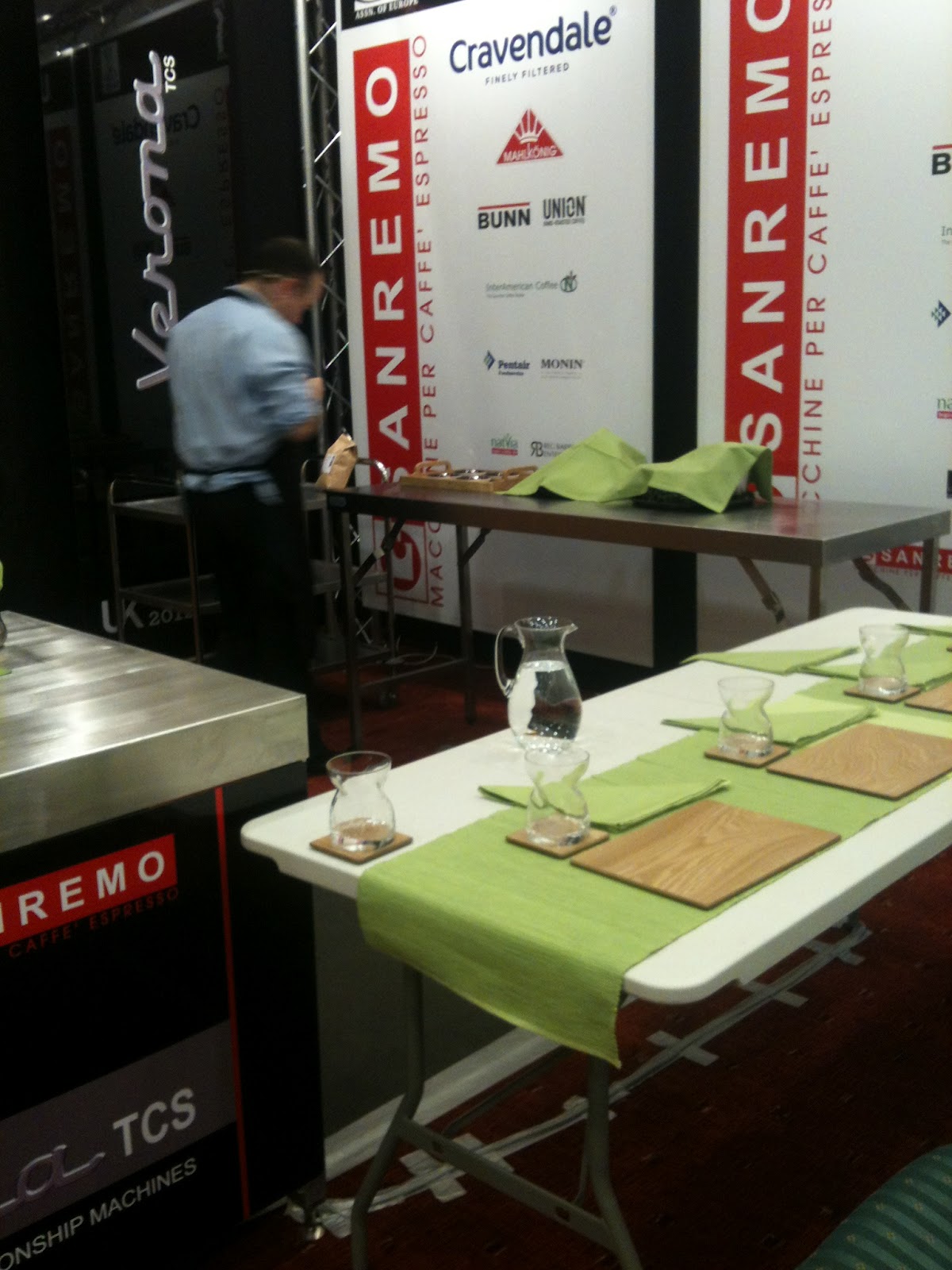
I had hoped to take more photos of the competitors and perhaps stream some live video, but ended up holding the video camera owned by San Remo, up at the front, so these pics are all I got.